The Infrastructure Question Behind Agentic AI's ROI
Agentic AI is producing strong returns for the enterprises that reach production. The infrastructure decision determining who gets there is getting far less attention.
Agentic AI is delivering an average ROI of 171 percent in 2026, closer to 192 percent for U.S. enterprises, with a median time to value around five months. For technology this new, that's a strong result.
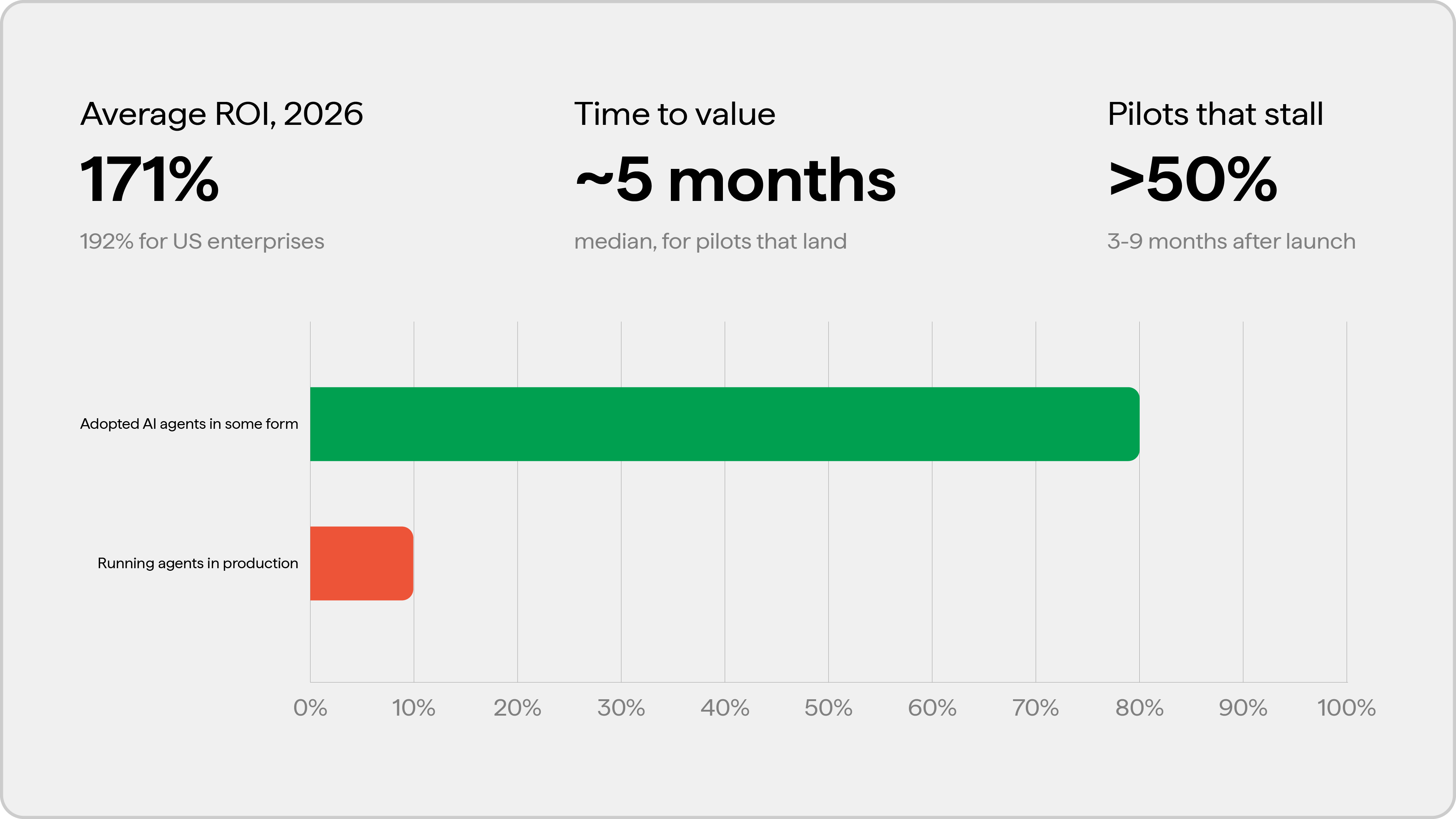
Those returns are coming from the minority of projects that actually reach production. Roughly four out of five enterprises have adopted AI agents in some form. Only about one in nine is running them in production. Of the pilots that succeed, more than half stalled out three to nine months later, after the demo worked and before the payoff showed up.
That gap usually isn't a model problem. It's an infrastructure problem the pilot's budget never accounted for.
Colovore has spent 13 years building purpose-built, liquid-cooled infrastructure for AI workloads that run hot, change fast, and depend on predictable, low-latency connectivity. Agentic AI is the latest workload to ask for exactly that combination.
What a Pilot Doesn't Show You
A pilot runs one agent, on one task, under light load. Production runs dozens or hundreds of agents at once, chained together, retrying failed steps, waiting on approvals. None of that shows up in a demo. All of it shows up on the infrastructure bill.
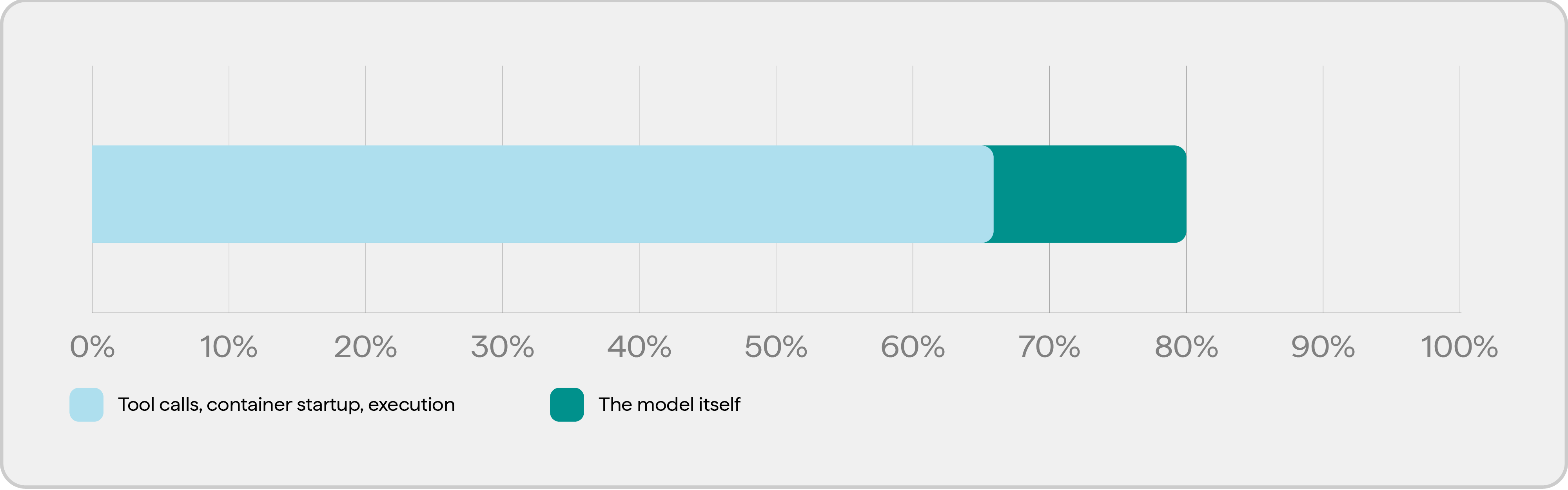
Studies of production agent systems find that tool calls, container startup, and general execution account for 56 to 74 percent of total task time. The model itself accounts for 26 to 44 percent. Most of the cost, and most of the delay, sits outside the model, in the layer most pilots never test.
That problem gets worse with idle compute. Enterprise inference deployments already waste 30 to 50 percent of GPU spend on idle or over-provisioned capacity. Agents make it worse: they burn real compute time waiting on a tool, a retry, or a human approval. Infrastructure built for a pilot's steady load doesn't hold up under production's uneven one.
One Chip Can't Run One Workflow
A single agentic workflow usually needs more than one kind of hardware. A small, fast model handles routing. A larger model handles reasoning. A retrieval system searches the company's own data. Each needs different hardware, and in production, all three often run at once.
Infrastructure optimized around a single hardware platform forces a compromise somewhere orpushes the workload across environments where every additional network hop adds latency. What must be sized isn't the model call. It's the whole loop: reasoning, retrieval, tool use, retries, and escalation.
Where the Risk Actually Sits
A customer service agent handling a billing dispute might chain three or four steps: look something up, check a policy, make a call. Each handoff is a place where context can get lost.
An operations agent that reconciles transactions or routes exceptions on its own carries a different risk. If it acts on bad data, that's not a wrong answer on a screen. It's an action that already happened and now must be undone.
A compliance agent reviewing transactions needs something most agent platforms weren't built for: a verifiable audit trail, not just a final answer. Without that, its conclusion can't be verified once someone asks how it got there.
In every case, the agent isn't just answering a question. It's taking an action inside a system that must account for it later.
Who's Already Building for This
JPMorgan runs more than 450 agentic AI use cases in production, drafting M&A memos, automating trade settlement, and flagging fraud in real time. EY's Canvas platform processes 1.4 trillion lines of audit data a year across 160,000 engagements in more than 150 countries. Salesforce's Agentforce platform orchestrates thousands of agents in production, including a deployment at Reddit that cut case resolution time by 84 percent. At that scale, memory, orchestration, and execution are infrastructure decisions, not settings in a dashboard.
In banking, several agentic AI platforms now offer private cloud, on-prem, and air-gapped deployment as standard, not an add-on, because data residency rules make a shared environment a non-starter. Oracle's financial services platform works the same way: consistent governance across on-prem, private, and public environments. These companies apply the same infrastructure discipline to agents that they already apply to anything that touches regulated data.
What the Infrastructure Actually Needs to Do
Keep latency predictable across the full chain, not just one call. A five-step workflow with a 20-millisecond hop at each step adds up fast, before the model even finishes reasoning. It adds up even faster in a shared environment where every additional network hop introduces more variability.
Run mixed hardware in one place. Routing models, reasoning models, and retrieval systems need to coexist without forcing a choice between them or splitting the workload across facilities.
Scale with concurrency, not just capacity. Ten agent chains running at once and ten thousand aren't the same problem. Enterprises need to grow into that without rebuilding the environment the pilot proved out on.
Give you control over where state lives. If you can't say where an agent's memory lives, who can access it, or whether it's been changed, you haven't solved governance. You've outsourced it.
The Question to Ask Before the Next Program Scales
Does the infrastructure your pilot is about to inherit look anything like what it ran on in the demo? For most companies, it doesn't, because the pilot was never built to answer questions about production concurrency, latency, or audit requirements.
What Colovore Provides
Density and flexibility for the full stack. Colovore's facilities support rack densities from traditional enterprise deployments through 600+ kW per rack, are HVDC-ready, and support NVIDIA, AMD, and other hardware in the same facility. That allows routing models, reasoning models, and retrieval layers to run together without forcing architectural compromises.
Latency that holds up across the chain. Colovore's Aurora and West Chicago campuses sit under 5 milliseconds from 350 East Cermak, Chicago's main carrier hotel, so every hop in a chained workflow stays on a private, predictable path.
Room to grow without rebuilding. Deployments scale from initial production environments to multi-megawatt AI infrastructure without requiring a new operating model.
Compliance built in. Colovore's Chicago campus is ISO/IEC 27001 and SOC 2 Type II certified, and is designed to support regulated workloads, including environments with PCI DSS and FedRAMP requirements. That gives you a place to keep agent state and audit logs under your own control.
The companies seeing the best agentic AI returns in 2026 didn't just pick the best framework. They built infrastructure that could handle what production actually demands, before the pilot ever left the lab.
This post is part of Colovore's ongoing series on the coming AI inference divide, the structural shift separating where AI is trained from where it runs in production at enterprise scale.
Read: The AI Infrastructure Decisions That Shape 2030
For the full analysis, including industry-specific use cases and the specialized silicon landscape, download the complete strategy paper.
Sign up for updates straight to your inbox
By subscribing you agree to with our Privacy Policy and provide consent to receive updates from our company.
Latest articles