
The Infrastructure Shift Behind AI in Life Sciences
As proprietary AI becomes core to scientific discovery, infrastructure strategy can no longer be an afterthought
For more than a decade, infrastructure strategy across healthcare and life sciences increasingly centered on cloud for new enterprise workloads. It delivered flexibility, scalability, and speed while eliminating the cost and complexity of building and operating infrastructure internally. For many enterprise applications, that remains the right strategy today.
Infrastructure strategy has always been about aligning technology investments with business priorities. As artificial intelligence becomes central to scientific discovery, those priorities are changing.
Across life sciences, investment in proprietary AI is accelerating to support drug discovery, improve molecular design, identify therapeutic targets, and better understand complex biological systems. AI is no longer just improving productivity. It is becoming central to how organizations create and sustain competitive advantage. As investment accelerates, infrastructure strategy is struggling to keep pace. The question is no longer whether to invest in AI, but whether an organization's infrastructure strategy can keep pace with its AI strategy.
Why AI Changes the Infrastructure Conversation
Organizations building proprietary scientific AI require more than compute. They need greater control over the infrastructure that underpins their valuable intellectual property and the flexibility to optimize the technology stack around their workloads. They face increasing expectations around security, governance, and regulatory compliance. At the same time, investors, partners, and patients expect scientific discoveries to move from the lab to commercialization faster than ever before.
Few life science organizations, however, aspire to become data center operators.
Building and operating AI infrastructure requires significant capital, specialized expertise, and long-term operational commitment. Those resources are better invested in scientific discovery than in designing, building, and maintaining data centers.
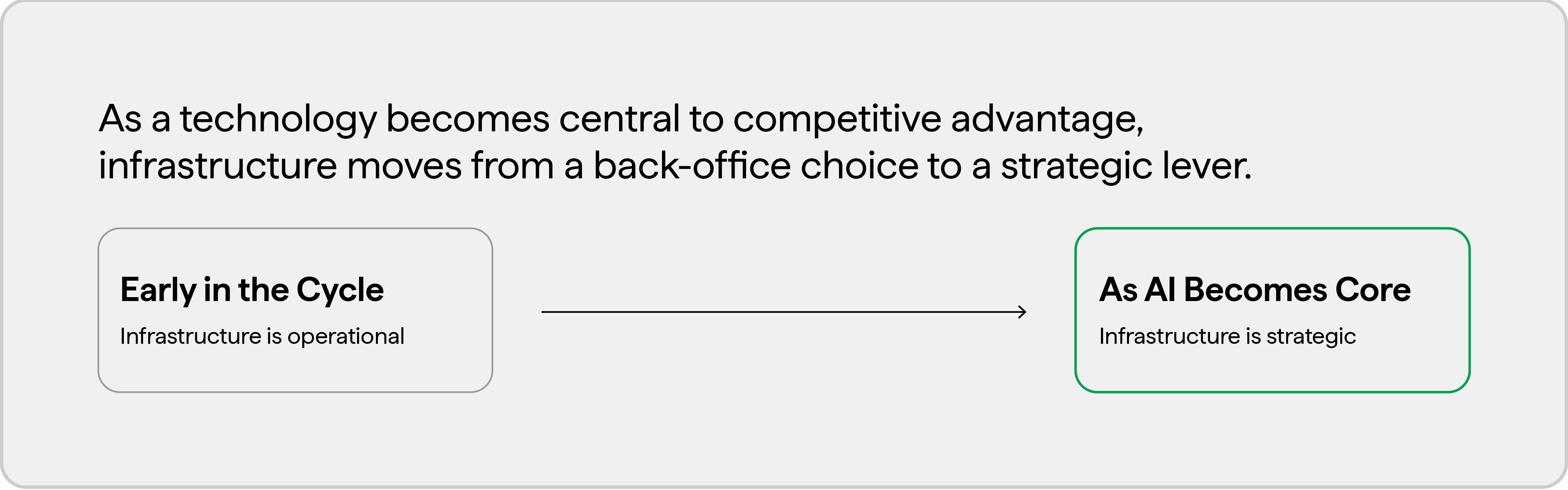
Every major technology transition changes the role infrastructure plays within an organization. Early in a technology cycle, infrastructure is largely an operational decision. Over time, as the technology becomes central to competitive advantage, it becomes a strategic enabler of the business itself.
The Real Tension: Control Without Ownership
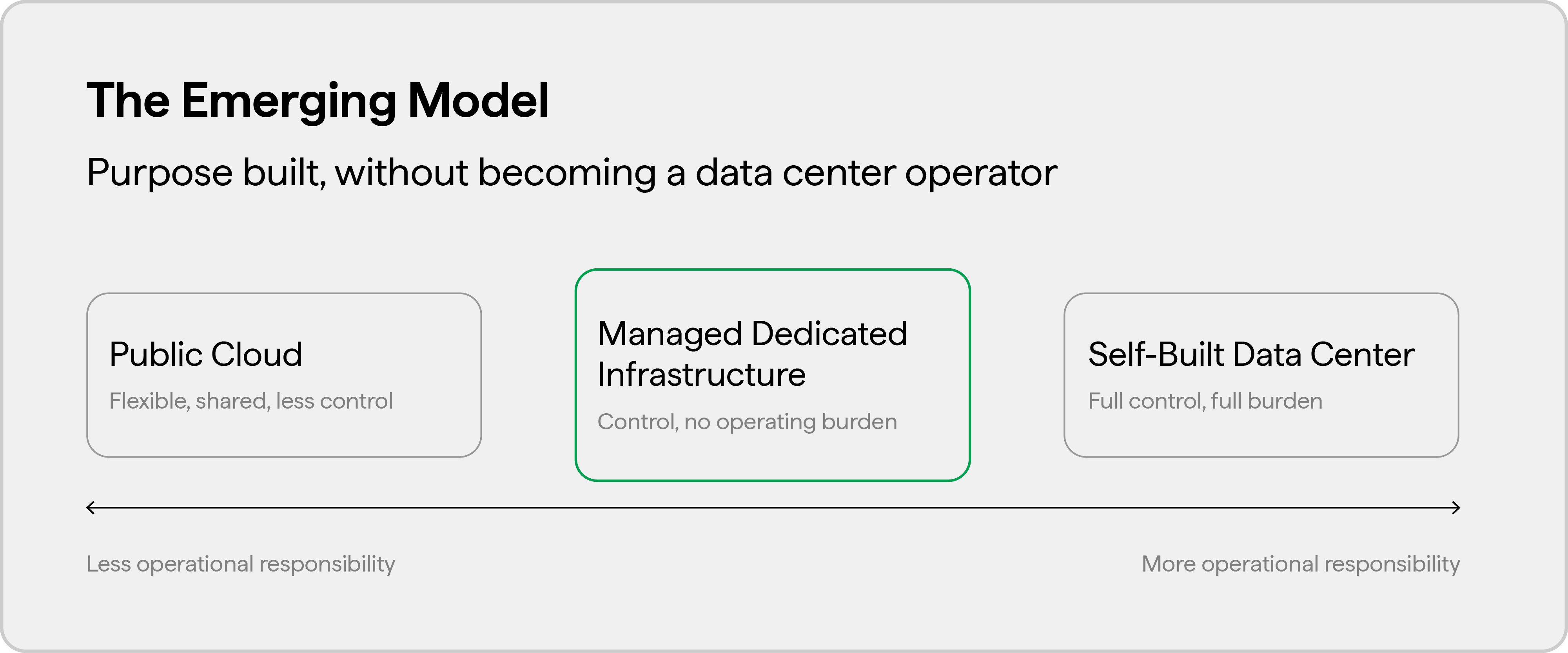
This creates a strategic tension for life sciences organizations. They increasingly need the performance, control, and flexibility of dedicated AI infrastructure without taking on the responsibility of owning and operating it themselves. The emerging model sits between those two extremes: dedicated, purpose-built infrastructure that organizations can control and optimize without having to build or operate the physical environment themselves.
Organizations building proprietary scientific AI are solving a fundamentally different problem than those simply consuming commercial AI services. They are building proprietary computational systems where models, data, software, and infrastructure become part of their competitive advantage. Their models improve through repeated training, larger datasets, and continuous experimentation. Scientific teams need to iterate quickly as discoveries emerge. Success depends not only on model quality, but on an organization's ability to continuously refine them. Infrastructure rarely determines what scientists discover. Increasingly, it determines how quickly they can move from one discovery to the next.
Rethinking Infrastructure Strategy
The shift is already visible across the industry. Life sciences organizations are investing in compute infrastructure, hiring machine learning infrastructure teams, and moving from pilot-scale GPU access to sustained, production-scale compute deployments. These are not isolated technology investments. They reflect a broader recognition that infrastructure strategy is becoming inseparable from AI strategy.
Scientific AI compounds these requirements because large biological datasets, computationally intensive models, and continuous experimentation create sustained demand for high-performance compute rather than the episodic consumption patterns many enterprise environments were designed around.
This is also where the traditional cloud-versus-on-premises debate begins to lose its usefulness. The real question isn’t where infrastructure resides. It’s whether an organization’s infrastructure strategy enables the pace of innovation the science demands.
For many workloads, the public cloud will continue to provide the right balance of flexibility and scalability. But organizations building proprietary scientific AI are increasingly evaluating infrastructure through a different lens. They are looking for infrastructure that provides the performance, control, security, and flexibility required to support rapidly evolving AI workloads over the long term.
The challenge facing many AI-driven life sciences organizations is not deciding whether to build infrastructure. It's determining how to access purpose-built AI infrastructure quickly enough to keep pace with scientific innovation without taking on the responsibility of owning and operating a data center.
The Next Competitive Advantage
As investment in AI continues to accelerate, competitive advantage will depend not only on AI strategy, but on whether an organization’s infrastructure can keep pace with it.
The organizations that lead the next generation of scientific discovery are unlikely to differentiate themselves by owning data centers. They will differentiate themselves by ensuring infrastructure never becomes a constraint on innovation.
Sign up for updates straight to your inbox
By subscribing you agree to with our Privacy Policy and provide consent to receive updates from our company.
Latest articles