Why Real-Time Industrial AI Needs to Run Close to the Plant
As AI moves from the dashboard into the control loop, latency and proximity become part of how the line actually performs.
For years, AI watched manufacturing. Now it's beginning to run it. As AI moves from dashboards into the control loop, infrastructure is no longer just where AI runs. It is becoming part of how the factory operates. In one recent industrial deployment, moving AI inference from the cloud to the edge reduced end-to-end latency from roughly 800 milliseconds to just 12. That's the difference between participating in the control loop and watching it happen.
That's the environment AI is moving into, and most manufacturers are still evaluating it like it's a dashboard.
Colovore has spent 13 years building liquid-cooled, high-density colocation for exactly this kind of workload: dense, latency-sensitive, and unable to tolerate a throttled chip or a slow network hop.
From Dashboard to Control Loop
For most of the last decade, AI on the plant floor meant analytics: a model reviewing sensor data after the fact, flagging something for a technician to check later. That model could live anywhere. A few hundred milliseconds of delay didn't matter, because a human was in the loop regardless. That's changing fast. Vision inspection, robotics coordination, and digital twin simulation are moving into the control loop itself, acting on decisions in near real time. Siemens and NVIDIA are building an “AI Brain” for adaptive manufacturing, starting with Siemens' Erlangen electronics factory in 2026, where the plant tests changes on its digital twin before pushing them to the floor. Samsung plans to convert its global manufacturing operations to AI-driven factories by 2030. PepsiCo's work with Siemens and NVIDIA uses digital twins to catch up to 90 percent of issues before a physical change is made, with early deployments reporting a 20 percent increase in throughput. Caterpillar, Foxconn, and Toyota are building physics-accurate digital twins of their own factories on the same platform.
Edge inference built for this is now hitting latencies as low as 12 milliseconds, down from roughly 800 milliseconds for the same workload running through a cloud round trip. That's not a small improvement. It's the difference between a system that can participate in the control loop and one that can only watch it happen.
Where This Actually Runs
Vision inspection has to catch a defect and trigger sortation before the part moves out of range. Late is the same as wrong: a defective part keeps moving as if it passed.
Robotics coordination sequences multiple arms against each other. A delay to one arm doesn't stay isolated. It cascades into every arm timed against it.
Predictive maintenance increasingly triggers a shutdown or adjustment directly, instead of just flagging an issue for review. That removes the human step that used to absorb a slow response, which means the model's speed is now part of the machine's own tolerance.
Digital twins only work if the plant and its simulation stay in sync continuously. A gap of even a second compounds fast across thousands of sensors feeding a physics model.
What It Costs to Get Wrong
Unplanned downtime averages close to $260,000 an hour across manufacturing. In automotive, it's over $2.3 million an hour, roughly double what it was in 2019. U.S. manufacturers lose an estimated $50 billion a year to it. Globally, the world's 500 largest companies lose close to $1.4 trillion, about 11 percent of revenue.
An AI system meant to prevent downtime can become a cause of it if its infrastructure adds latency the control loop can't absorb. A vision model that occasionally takes 400 milliseconds instead of 40, because it's sharing a scheduler in a distant cloud region, doesn't just answer late. It can break the timing assumptions the whole line was built around.
Why This Isn't Just an Edge Computing Problem
A modern plant runs several kinds of AI workloads at once: vision, robotics, and simulation, each with a different hardware profile, all needing to run close to the plant.
On top of that sits a security standard most IT teams weren't built to satisfy. IEC 62443, the leading cybersecurity standard for industrial control systems, emphasizes the availability and resilience of operational technology, and its scope increasingly extends to industrial IoT and cloud-connected systems that interact with field equipment. A facility that can't deliver consistent, predictable performance creates operational challenges long before the AI model is even evaluated.
A plant locked into one vendor's hardware for vision AI still has to make separate decisions for robotics and simulation, or accept compromises across all three. As each of those evolves on its own timeline, a facility that can't support more than one architecture becomes the thing holding the plant back.
What the Right Infrastructure Looks Like
Close enough to matter. Latency-sensitive industrial AI needs to sit near the plant, not in a distant region chosen for price per kilowatt.
Built for mixed hardware running at once. Colovore's facilities run 5 to 600-plus kilowatts per rack, HVDC-ready, with liquid cooling built in as standard, not a special request.
Neutral on hardware. Colovore supports NVIDIA, AMD, and other architectures in the same facility, so a plant isn't locked to one vendor for the life of a robotics or digital twin deployment.
Built for OT-grade requirements. Colovore's Chicago campus is ISO/IEC 27001 and SOC 2 Type II certified, Tier 3 rated, with a 99.999 percent SLA and 100 percent uptime since day one, meeting both IT security review and the timing standards OT engineers already expect.
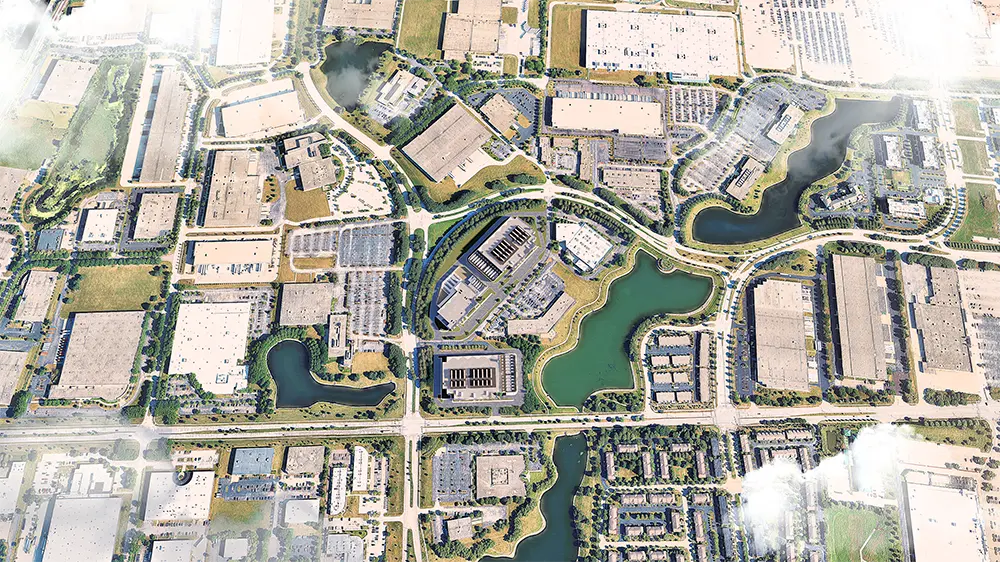
Colovore's Aurora and West Chicago campuses sit inside one of the country's biggest manufacturing and logistics corridors, with 54 megawatts coming online across four sites through 2028, and the first hall live in December 2026. Space in the Chicago metro is already tight. Manufacturers securing capacity now won't be stuck rebuilding their AI strategy around a capacity problem two years from now.
The Question to Ask Before the Next Deployment
If a vision, robotics, or digital twin system depends on a hop to a shared, distant environment, what happens to the line the day that hop is slow? Most manufacturers haven't had to answer that question yet, because the AI that used to sit outside the loop never required it. It does now.
This post is part of Colovore's ongoing series on the coming AI inference divide, the structural shift separating where AI is trained from where it runs in production at enterprise scale.
Read: The AI Infrastructure Decisions That Shape 2030
For the full analysis, including industry-specific use cases and the specialized silicon landscape, download the complete strategy paper.
Sign up for updates straight to your inbox
By subscribing you agree to with our Privacy Policy and provide consent to receive updates from our company.
Latest articles